What impact will U.S. News & World Report's new formula for calculating the "employment at 9 months" variable have on next year's law school rankings? Most importantly, it will make the rankings more accurate. No longer will a law school be able to arbitrarily increase its rank by strategically classifying unemployed students studying for the Bar exam as "unemployed, not seeking employment." Even though flaws will continue to mar the Emp9 measure, as well as other aspects of USN&WR's methodology, we can look forward to a better and fairer assessment of law schools in next year's rankings.
The Emp9 formula that will kick in next year might not make everyone happy, however. It will doubtless cause some law schools to fare less well in the upcoming (the "2009") USN&WR rankings than they did in the most recent (the "2008") rankings. Which schools will drop in the rankings, and by how much? That is of course impossible to say. We can estimate the new Emp9 formula's future impact, however, by making it hypothetically effective a year earlier. I did just that, using my model of the 2008 rankings. Herewith the results:
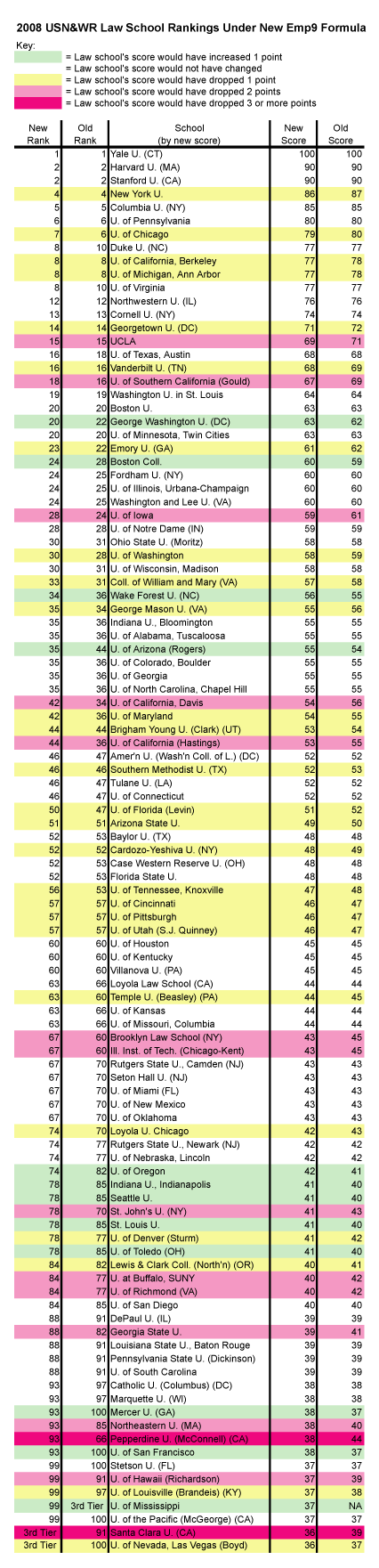
In addition to those results, my experiment indicates that implementing the new Emp9 formula a year earlier would have caused:
Florida International University School of Law to fall from the third tier into the fourth tier (to a point about 1/3rd down from the top of the fourth tier);
Valparaiso University School of Law to (just barely) escape from the fourth tier to the bottom of the third; and
Northern Illinois University School of Law to leap from the fourth tier to a point well up from the bottom of the third tier (about 1/3rd of the way up from the bottom of that tier).
How did I come up with these results? First, I downloaded the February 2006 employment data that the American Bar Association published for each law school it accredits. Second, I ran that data through the formula that USN&WR plans to use to calculate Emp9 scores in next year's rankings. Third, I plugged the resulting Emp9 scores into my model of the most recent rankings, substituting it for the Emp9 scores USN&WR calculated under its old formula. That gave me new scores for all the schools ranked by USN&WR. To best estimate the impact of the new formula, though, I didn't just use those scores. Rather, I added or subtracted to the scores USN&WR published for each of the law schools in the top two tiers of its 2008 rankings the difference between what my model had originally calculated for those schools and what it came up with under the new Emp9 formula. (For schools in other tiers, though, for which USN&WR does not publish scores, I simply compared the model's original and recalculated scores.) That generated the final result: an estimate of what effect the new Emp9 formula would have had had it been instituted this year.
Please allow me to emphasize that this experiment does not suffice to predict next year's rankings. My model does not perfectly mimic USN&WR's law school rankings, which at any rate rely on much more than only Emp9 measures. Also, as I observed earlier, it appears that for a few schools USN&WR used different Emp9 numbers than those published by the ABA. I of necessity used the latter numbers for this exercise. Speaking only as a rankings geek, though, I daresay that even these admittedly imperfect results prove interesting.
After spending about 6 hours at Newark's ironically named Liberty International Airport last night, I am finally back from the Law and Society Meeting in Berlin. Here are some jet-lagged thoughts:
It's all about the hallways. I've been going to LSA meetings since 1994 (I remember watching the OJ White Bronco chase from the swim-up bar at the Arizona Biltmore with a number of equally mesmerized colleagues that year. -- I don't remember taking peyote, but that was the most hallucinatory moment of my life). LSA is always a very amorphous meeting -- the LSA umbrella is so big at this point that I'd imagine there are very few in the legal academy today who do work that couldn't be presented at LSA. Thus, the meeting can feel very disjointed, with lots of sub-groups and cliques. I spent lots of time catching up with old friends and meeting a number of people I know only through their work or their blogs, but it feels now more than ever like LSA is a number of different meetings that just happen to be occurring in the same time and space.
"New" is the new "(Re). The joke used to be that every LSA panel featured the phrase "(Re)Imagining" "(Re)Conceptualizing " or "(Re)Evaluating" in the title. Now, the thing seems to be "New". So there were panels on, at least, the "New Legal Realism," the "New Formalism," the "New Governance" and the "New Punitiveness". (Jeff Lipshaw has a very good post this morning on the "New Formalism" panel on which he appeared.)
Berlin is an incredibly evocative place. I know that there was a lot of discussion before the meeting about whether people of color could feel comfortable in Berlin in light of the recent racist attacks that have been taking place there. For those of us who are Jewish, being in Berlin presented a very different set of concerns. My mother was born in Berlin and left with her family in 1939, a full year after Kristallnacht; so it was strange to me that my comfortable and luxurious hotel was 2 blocks from the former SS headquarters, where the killing of Europe's Jews was meticulously plotted and carried out. The city is both full of reminders of the atrocities that were carried out there -- it has numerous monuments to the victims of the holocaust -- and in other ways completely detached from its past. For example, unless you knew its history, there are very few hints that 20 years ago a wall divided the city in two. Again, Jeff Lipshaw (whose family history seems eerily similar to my own) wrote about this some at Prawfsblog.
I've offered a series of posts in recent months about how the "employment at 9 months" variable functions (or, rather, misfunctions) in U.S. News and World Report's law school rankings. As I explained in the first of those posts, "USN&WR's Emp9 formula allows a law school to score notably higher in the rankings by characterizing those of its graduates both unemployed and studying full-time for the Bar as 'unemployed and not seeking work' rather than as 'unemployed and studying for the Bar full-time.'" That observation led me to pose six questions:
Why does that classification strategy benefit law schools?
Which law schools pursue that strategy?
How much do they benefit from it?
Is that ethical?
How did we get into the mess?
How do we get out of it?
I offered my answers to the first three of those questions in an earlier post. I here tackle the remaining three.
Is that [i.e., strategically answering Emp9 questions] ethical?
I admit to having no particular expertise in ethical matters. I hesitate to judge law school administrators, moreover, as I can only imagine the intense pressures they face when they fill out their ABA and USN&WR questionnaires. And what I (or anyone) thinks probably doesn't matter much, anyway, given that USN&WR has changed its Emp9 formula to henceforth avoid this particular ethical conundrum.
I daresay, though, that the better fit offered by "unemployed and studying for the Bar full-time" makes it suspect to instead call graduates "unemployed and not seeking work." The latter classification plainly aims to cover graduates who, like trust-fund kids or new parents, choose to not work as attorneys. In contrast, anybody studying for the Bar nine months after graduating law school almost certainly failed the exam the once, wants desperately to pass it the second time around, and would seize almost any law firm's job offer. To classify such a person as "unemployed and not seeking work" demands a justification.
I don't think it would suffice to answer, "Everybody else does it!" Not everybody does. Nor would some vague appeal to the inherent unfairness of the rankings move me—especially given that innocent students rely on law schools to reply forthrightly to the ABA and USN&WR questionnaires.
I find most convincing the claim that, so long as it does not out-and-out lie, a law school can describe itself as advantageously as it likes. That argument recalls the tax attorney's refrain that no obligation exists to pay the government more than legally required. On that view, USN&WR offered a loophole that only the inattentive or foolish would forego. So, at least, goes the best argument I've heard for answering USN&WR's Emp9 questions strategically. Whether "best" here rises to "good enough," though, I cannot say.
How did we get into the mess?
USN&WR wrote its Emp9 formula poorly and then failed to fully disclose the ramifications. Some schools evidently found and exploited the resulting loophole. Some law schools doubtless considered and rejected that route. Still other law schools never even knew that they might have benefited from strategically characterizing their Emp9 data. USN&WR should either have chosen a better formula in the first place or at least have made sure that all law schools knew how its Emp9 formula (mal)functioned.
How do we get out of it?
USN&WR has now adopted an Emp9 formula that will disallow the sort of strategic reporting that has marred recent editions of its law school rankings. That should cure the problem at hand. Even USN&WR's revised Emp9 measure will remain subject to a variety of tricks, however, such as law schools temporarily hiring their own graduates or adopting creative definitions of "pursuing a graduate degree."
Let's return to fundamentals. Why does anyone care about post-graduation employment, anyway? First, because law students generally plan to practice law and, second, because they usually want to earn at least enough to pay off their law school debts. We can surely find a better way to convey that information than the current Emp9 measure. We might, for instance, track the percentage of graduates who have jobs requiring a J.D. or even Bar membership. Or we might calculate the average "new graduate's monthly salary/new graduate's monthly law school debt payment" ratio for each law school—that's a number that would-be law students would surely find useful.
There probably exist other, even better ways to figure out how well law schools serve their students. How can find those alternatives to USN&WR's Emp9 measure? By pursuing reforms that will make the assessment of law schools more transparent, accurate, and competitive.
AngryLittleGirl, an emerging YouTube superstar, has created a video that expresses a sentiment felt by many bar takers. Click on the picture at left to play the video.
Most law schools go through it from time to time – budget cuts, call backs, etc. The truly unfortunate part is that they are likely to hit untenured people hardest. As usual, the people least able to afford it pay the toll for the privileged professors they work along side.
There is an upside. If a faculty is bloated with special interest and boutique courses, a freeze can mean trimming some of the fat and requiring the privileged ones teach what they promised to teach, indeed what they craved to teach, when they were hired. You must recall all those interviews of people now jockeying for the smallest possible class and fewest students -- "I just realized one day that my first love is teaching," "Of course, I'd love to teach torts." These are the same people giving 100% multiple choice machine graded final exams.
And there are the "programs." We all know law school administrators do not like to say “no” to faculty regardless of how wacko the proposal. After all, faculty approval, not doing what is best for stakeholders, is a principal decanal focus for many administrators. Why cut a $50K program that serves nothing but faculty ends when a) faculty will whine and b) it's someone else's money you are spending.(Put up your hand if you took at least one summer vacation trip largely on the dime of your law school under the guise of a "program" or "conference." Whoa. Keep’m up -- it will take some time to count all those.) Funny how spending the money of others always leads to a skewed cost/benefit analysis.
Yes, a budget squeeze is just the ticket to test the pulse of an administration. Is it willing to require hiring committees to focus only on high need areas? Is it willing to tell faculty that they are needed to teach bread and butter courses. Is it willing to cut programs based on benefit to stakeholders or will the ones favored by members of the administration or its closest friend be the ones that go?
Moneylaw co-contributor and blog entrepreneur Paul Caron turned fifty today. More on this, and an explanation of the graphic, at Legal Profession Blog.
I earlier discussed U.S. News and World Report's plan to change the way it measures "Employment at 9 Months" for its law school rankings, a change that will make it harder for schools to game their Emp9 numbers. An anonymous commentator on that post asked, "Anyone want to recompute the 2008 rankings using this 'more accurate' methodology based on the figures conveniently made available by the ABA in excel format?" I had to admit that the project would generate interesting results. And since I've created just such a model of the 2008 rankings, I figured I was the guy for the (tedious and nonpaying) job. That labor of love generated interesting results sooner than I'd expected, however.
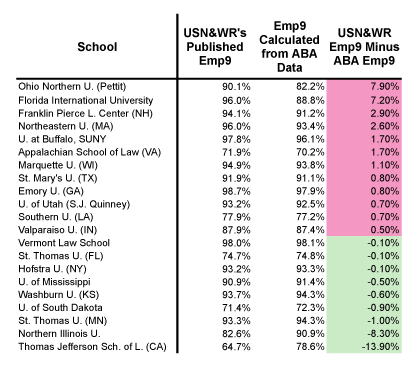
USN&WR's published rankings include each law school's Emp9 score. The magazine calculates those scores using data from questionnaires it sends to the law schools it ranks—questionnaires that ask each school to repeat what it earlier said in reply to the American Bar Association's annual questionnaire. Happily for ranking geeks, the ABA recently began publishing that data in a downloadable Excel file. But when I plugged that ABA data into USN&WR's Emp9 formula, I discovered that it did not always generate the Emp9 scores that USN&WR used in its 2008 rankings. Herewith the problematic cases:
I see four explanations for these divergences: 1) Errors in the ABA data; 2) Errors in the USN&WR data; 3) Errors in my calculations; or 4) Differences between what a law school told the ABA and USN&WR. The first two explanations seem most likely to me, but I of course cannot rule out the third. As for the last, it bears noting that a school's Emp9 data comes from the prior February—seven or eight months before a school fills out its ABA and USN&WR questionnaires. It's thus hard to imagine how a school could dig up new data, after so long a remove, in the relatively short span between when it fills out the former questionnaire and the latter.
With luck, I'll have firmer answers, soon. I've emailed administrators at the four law schools that stake out the extremes on the above list, asking if they could please help me understand this phenomenon. That out of the way, I plan soon to return to my original goal: recalculating the 2008 USN&WR rankings using the Emp9 formula that will officially take effect next year.
I have often defended blogging as the great academic equalizer by noting that women law professors (or I should say parenting law professors) may find it easier to balance blogging with home life than traveling for conferences. I have responded to critics of time-intensive blogging that networking through blogging may be a substitute for networking through conferences, which can be costly in terms of time and money.
Perhaps because of the demographics of my field (corporate law), I often go to conferences where women law professors are in the minority. Last year in fact I was the sole female panelist at a day-long conference with 10 or so speakers. I've really gotten to where I don't notice much any more. I was talking about this with some other female corporate law professors, who have decided that when asked to speak at a conference, they also make suggestions of other possible female speakers to be invited (to counteract any network effects similar to the ones that Eugene discussed). However, I know at my almost all-male conference, many speakers suggested two other female professors who wrote in the field, and they declined. So, my question to readers is whether women law professors feel that they must pick and choose their conferences more so than their counterparts due to child care responsibilities or other work/life issues.
Obviously, pregnancy takes a female law professor out of conference rotation for at least a month or so before the birth and several afterwards, depending on nursing decisions, etc....However, blogging is much easier, and more invisible than attending conferences. Why I could be eight months pregnant right now, and you would never know.
Really interesting post. I agree with Christine that blogging is an important but underrated networking tool. The year between the J.D. and the LL.M I spent helping take care of my aged parents and being the Glorified Unpaid Nanny for my nine nephews and nieces definitely drove home the physical (and in my case, intellectual as I wasn't in an academic environment) isolation that comes with family care.
Blogging has certainly brought me in contact with scholars in my field and more widely. I've become aware of real-life networking conferences through blogs (Legal Theory Blog is the best clearinghouse for this). This doesn't mitigate the costliness of conference travel--something that is all the worse when you're a student classified as a professional student and your school doesn't help pay for conferences at all. Even if I were classified in the graduate division, I wouldn't get much funding. So blogging is a good networking tool for family care providers and grad students alike.
Regarding the gender gap, I often think about how blogging has helped circulate my name and work in ways that are very difficult through bricks-and-mortar ways such as conferences. My main field, employment discrimination law--where there is a better balancing of genders--isn't my reason for the gender gap. The gap I see is endemic to the academic environment. It takes a lot of legwork to get your name out! I remember my Las Posadas like approach to introducing myself to various faculty at my school. Setting up appointments, actually going up to the doors and knocking, and a lot of handshaking. And even then, I wouldn't say that brought particularly deep and sustained interaction (now that I'm basically in the writing phase, it's far better that I write and circulate than keep taking classes or go to office hours). Meeting someone does not a draft-reader make. My school suggets being a research assistant. Great! But that takes too much time away from writing, and that would bring me into deeper contact with just one faculty member. Because my recommendation letters should speak to my strengths as an academic, I think I'd rather build that relationship with my dissertation advisor--whom I should be showing my own work, rather than doing theirs. I'm not discounting RA-ships. I'm just saying that I think it's better to go for depth rather than breadth in terms of the people you get to go to bat for you from your actual home institution. In social network theory terms, this is called "the strength of ties"--you want deep mentoring relationships, and you should have one with the person supervising your written work.
For breadth, blogs are awesome. Blogs will circulate your name and work far more widely across the nation. Never underestimate the strength of weak ties for alerting you to conference opportunities or job openings, or just advice. Most of my readers aren't even from my geographic location, but they are in my field. I would have to say that blogging has been more effective than just posting abstracts and drafts on SSRN in terms of getting feedback and "meeting" people. There's something about the inherently conversational space of the blog and comments section. I think regular blog readers invest more time and solicitude in the blogs they frequent. I honestly believe that to some of my readers, I am their mentee, and thus I have had several professors offer me (or rather, Belle) advice and support via private email. That then led to much fuller and deeper mentoring relationships. When I post a question, the commenters come in with useful advice--the quick, low-investment way to help. When I have more private concerns or don't wish to appear that I am conducting my life by poll (what classes should I take? is a question I love to ask), my email mentors come in. Email is a very low-cost, on-your-own-time way to be a mentor or mentee.
I'm telling you, don't discount this digital age. But chug away at the bricks-and-mortar way of networking too. Just have a two-tiered approach to how much interaction, responsiveness, and strength of tie you can pursuse in each medium.
By way of the Chronicle's On Hiring Blog, MoneyLaw has learned of Dean Dad's observations on academic hiring. "Dean Dad" works in a community college, but his wisdom applies at all levels of academia. In reply to a correspondent who wondered whether academic employers might be legally required to "hire the job candidate who is most qualified," Dean Dad identified a host of additional factors affecting academic hiring:
"[I]t's not at all unusual to have to turn down people who exceed the qualifications for a given position. . . . For one fairly recent hire, we had 120 applications, several of which were far beyond anything we had dreamed of anticipating. As good as they were, we had to turn down all but one. . . . [But] we only had the one position."
When "top candidates [bring] credentials far beyond what the incumbent faculty had when they were first hired," it's impossible to "buy the 'academia is a meritocracy' line": "In a meritocracy, incumbents would have to defend their positions against newcomers. With tenured faculty, that doesn't happen."
"[S]ome people who seem great on paper just don't get it done 'live,' whether in person or on the telephone. I've seen exceptionally well-credentialed candidates stumble on the simplest questions, simply because their priorities were wildly different from ours. I've seen candidates adopt the attitude that they're doing us a favor by deigning to consider working here: that's always the kiss of death. And there are always those mystifying failures of basic communication skills -- monosyllabic answers to everything, answering questions other than the ones that were asked, or basic incomprehensibility."
"There may be salary constraints such that the topmost candidate is essentially priced out of the job. (That can easily happen in a collective bargaining environment, in which starting salaries are determined by a pretty mechanistic grid. If you score too high on the grid, the college might decide it can't afford you, and if it did a lowball offer, it would lose the grievance.)"
"[A] college might be spooked by 'flight risk.' If a college has lost several rising stars recently to raids, it may decide to lower its sights for a while in hopes of retaining people without raising its pay scale."
"[A]ffirmative action . . . can be a wild card."
"And then there are all the usual human failings.
Some colleges have cultures of 'waiting your turn,' in which longterm adjuncts are kept loyal through implied promises of being 'next.' Some committees won't take seriously anybody who isn't already there.
Some chairs reward personal loyalty over performance, or don't perceive the difference between the two.
Sometimes committees split, and the minimally-acceptable-to-all 'dark horse' candidate wins, despite being nobody's first choice.
Sometimes a formally open job is given to a trailing spouse in order to maintain local comity, or to reduce flight risk."
"And sometimes people just get it wrong. It happens."
Dean Dad's closing observation offers hope to the entire academic market:
The market is brutal enough that any given rejection shouldn't be taken as a reflection on the candidate.
The AALS workshop on law school rankings took place in January 2007, but it's never too late for the Jurisdynamics Network's technology staff to add value to this program and to present it in readily digestible form for the benefit of MoneyLaw's loyal readership.
In this session, speakers will confront the #@%$&**@ U.S. News and World Report rankings system. From sharing the folklore of law school behavior (good and bad), to discussing specific effects on law school admissions practices, to describing the games we sometimes play, to wondering about the effect on our moral leadership, the panel assumes that the rankings are not going away and ponders what to do about it.
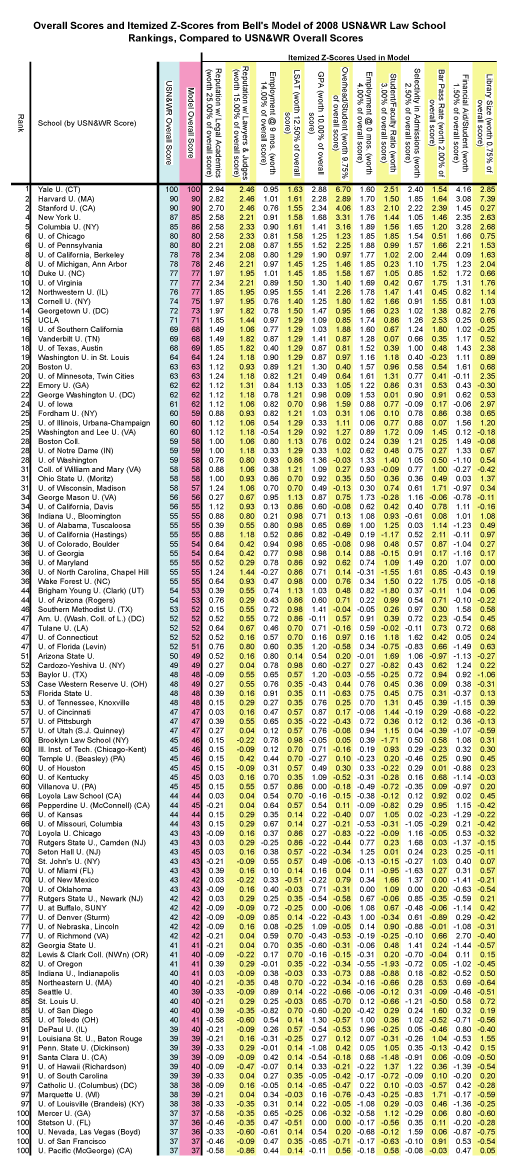
As in 2005 and 2006, I'd like to offer z-scores from my model of the most recent U.S. News & World Reports law school rankings:
Why should you care about a law school's z-scores? As I explained last time around, "z-scores, derived from the data that goes into the rankings, represent the penultimate step to calculating each law school's overall score. In some sense, the z-scores matter far more than the raw data about each school's reputation, LSATs, and so forth."
I limited my disclosure of the model's z-scores to only those law schools for which USN&WR publishes overall scores—the schools in the top two tiers of its rankings. USN&WR lists schools in the third and fourth tiers alphabetically. Although my model allows me to estimate those school's scores, and thus to rank them, I've thus far decided against publishing that data. For my reasons, please see this prior post.
Editor's note: The law school dean continues to recycle newspaper and newsletter columns composed during his first semester on the job.
When I left the University of Minnesota in January to join the University of Louisville as the dean of its law school, I crossed two rivers. To be precise, I crossed two branches of the mightiest river system in North America: the Mississippi River between Minneapolis and Saint Paul and the Ohio River from Indiana into Kentucky.
These cities exist because they lie at the fall lines of the Mississippi and the Ohio. As a native of our larger region, I am at once blessed and haunted by the geographic awareness that comes with the sense of place unique to the American South. For generations the Falls of the Ohio dictated Louisville's destiny. To this day, high ground and flood plain define neighborhoods in our community. Lewis and Clark understood the Falls as the gateway to the west. The industries that built Louisville and Kentucky in the nineteenth and twentieth centuries exploited the power of falling water.
Legal education is a metaphorical river crossing in its own right. The decision to attend law school, irrespective of age or personal circumstances, defines a crucial point of transition in the life and career of any student.
For younger students, only recently graduated from college, coming to law school at the University of Louisville represents a commitment to a profession, to an electrifying way of thinking and of doing that distinguishes those of us privileged to have been trained in the law. Likewise, students seeking a change in their career trajectories will find in law school the opportunity to revitalize their professional lives.
The University of Louisville proudly provides all of its students with the training and the opportunity to transform themselves. We at the law school, like all of our colleagues throughout this university, are dedicated to the higher training and useful education of our aspiriing youth. The diverse experiences that our students bring to law school matters enormously. Their hopes, their futures, their destinies matter even more.
Our law school, like the community that sustains it and the students and constituents it serves, has grown deep like the rivers. It is the calling of a lifetime to serve this school, this university, and this community. I am profoundly honored to serve as the dean of the Louis D. Brandeis School of Law at the University of Louisville.
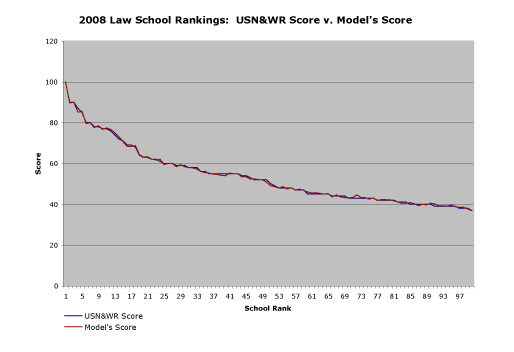
As in years past, I again this year built a model of the most recent edition of U.S. News & World Report's law school rankings. Apart from the intrinsic charms of the exercise (not inconsiderable to a rankings geek), it offers useful insights into how USN&WR assesses law schools. Last year, for instance, comparing the model's results to USN&WR's published scores uncovered some troubling errors. What did reverse engineering the 2008 rankings uncover?
This year found me especially eager to find out how well my model would track USN&WR's law school rankings. After many sleepless hours massaging the data, I boarded a flight, squeezed in between two beefy road warriors, downed some coffee, and began muttering over my laptop. It doubtless startled my neighbors when, some time later, I thumped the return key, leaned back in my seat, raised my fists, and exclaimed, "YES!"
The above chart, which compares USN&WR's scores to those generated by my model, explains my triumphant glee. As you can see from comparing similar charts from 2005 and 2006, this year's model proved the most accurate, yet. That alone sufficed to put me, literally, in geek heaven.
That close fit between the published rankings and the model heralds good news more generally, too, though. It indicates that USN&WR ranked the top two tiers of law schools using data not grossly different from the data collected by the American Bar Association. My model uses the ABA data, you see. The congruence between the two sets of scores thus means we have less reason to worry this year than in years past that a law school gamed the rankings by telling USN&WR something different from what it told the ABA, or that USN&WR somehow mishandled the data.
If you like the USN&WR rankings, that should make you happy. And even if you don't much like them, you surely want the rankings to stick to the facts. (Or perhaps I should say, given doubts about many of the measurements that USN&WR uses, you surely don't want its rankings to reflect non-systematic errors.)
The University of Louisville's mission statement directs this university to "be a premier, nationally recognized metropolitan research university with a commitment to the liberal arts and sciences and to the intellectual, cultural, and economic development of our diverse communities and citizens." No word in this sequence has proved more controversial than metropolitan. After all, what would be lost if our university deleted the word metropolitan and strove simply to be "a premier, nationally recognized research university"?
As dean of the University of Louisville's Brandeis School of Law, I welcome and embrace our school's designation as a metropolitan research university. We strive to be a metropolitan law school. We are, to coin a phrase, comfortably metrotextual.
Received wisdom in Kentucky treats the word metropolitan as a means of impairing rather than inspiring the University of Louisville. Our commonwealth, after all, supports at least one other nationally recognized research university. A related line of conventional thought assigns American universities to a hierarchy based roughly on nomenclature. Ideally, so this thinking goes, a university should be named for a wealthy individual (Leland Stanford, Jr., or Cornelius Vanderbilt), or perhaps the largest available piece of real estate. Virginia, Michigan, or Texas will do.
In many cases, and this is one of them, received wisdom isn't truly wise. Some of the finest universities in our country are named for cities: Chicago, New York, Los Angeles, Boston, Pittsburgh, Cincinnati, and, yes, Louisville. Many of the most prestigious universities outside our country are named for their cities: Oxford, Cambridge, Toronto, Salamanca, Bologna, Heidelberg. Several colleges within our metropolitan university -- including the Law School -- have added the names of individuals who were giants in the earth in their days, mighty men of old and of renown. As much pride as the University of Louisville justifiably takes in Justice Louis D. Brandeis, Raymond A. Kent, and J.B. Speed, I draw ample motivation from the name that unites our law school and our university with our city: Louisville.
Shakespeare's Juliet rightfully asked, "What's in a name?" The University of Louisville proudly bears the name of the city and the broader metropolitan community that sustains it. The central problems of our time are the problems of cities, of urban conglomerations so potent as to transcend earlier generations' conception of the "metropolis." To paraphrase the popular singer-songwriter, Natalie Merchant, "A woman of beauty / A woman of pain / In France or Jakarta" faces frustrations and harbors dreams every bit as much as "A woman of color / With debts to be paid / In Trenton or Detroit." At home or abroad, "Her shadow's the same."
By the same token, the world's metropolitan research universities hold the key to a brighter future for ourselves and our posterity. In his epochal book, The Rise of the Creative Class: And How It's Transforming Work, Leisure, Community and Everyday Life, Richard Florida quotes what he calls an "old German adage": Stadtluft macht frei. City air makes you free. Yes, today's cities generate many of the problems that confront contemporary societies. Led by their universities and their most engaged citizens, those cities offer hope. They offer solutions.
Here at the University of Louisville, in the heart of the city of Louisville, our Law School is comfortably metrotextual. We have ambitiously set forth a metropolitan agenda.
What does it mean to be a metropolitan law school? I believe that these are the irreducible elements:
Access. A metropolitan law school, especially if it contributes to the grander mission of a metropolitan university, stands as a beacon of hope and opportunity. Our Law School proudly serves first generations and provides second chances. It does so by undertaking -- and fulfilling -- the strongest possible commitment to diversity and financial aid. The University of Louisville provides one of the best bargains in American legal education. It is the solemn mission of the dean to ensure that our Law School extends this tradition for the benefit of current and future generations.
Excellence. In order to succeed in accomplishing its access mission, a metropolitan law school must strive for excellence. Lowered academic standards would destroy the entire notion of access, for a university that has retreated from its commitment to excellence would make, in the words of Justice John Marshall Harlan the elder, a splendid but worthless bauble of educational opportunity. Our Law School strives for nothing short of superlative instruction, counseling, and research.
Service. A metropolitan law school is a leading citizen of the community that sustains it. The University of Louisville has been a pioneer in integrating public service into the law school curriculum. For nearly two decades, our law students have fulfilled a rigorous public service requirement as a condition of graduation. With the support of our university, our alumni and alumnae, and Louisville's legal community at large, the Law School hopes very soon to open a new University of Louisville Law Clinic. We hope that our Law Clinic, in addition to providing hands-on training that will enable our graduates to perform at their very best upon their entry into the legal profession, will deliver much needed services to the neediest and least served segments of our community. I can think of no greater development in the living memory of legal education at the University of Louisville.
At roughly 460 feet above sea level, the University of Louisville sits at the lowest elevation of any public university in Kentucky. We nevertheless stand tall. By transforming its mission as a metropolitan research university into a profound educational mandate, the Law School hopes to help its university, the legal profession, and Louisville at large become a true beacon of hope -- a veritable city on a hill.
Robert Morse, U.S. News and World Report's director of data research, blogs: "In the upcoming edition of America's Best Graduate Schools, U.S. News will change the way it computes the percentage of law school graduates employed at graduation (and nine months after) as result of changes made by the ABA in its questionnaire." The changes aim to stop schools from gaming the "Emp9" measure, a practice I describedearlier.
Specifically, the ABA and USN&WR will now force law schools to classify graduates as either employed, going to graduate school, or unemployed. No longer will schools face the temptation to hide bodies in the "graduates who are unemployed and not seeking work" category—a trick that removes students from the denominator of the Emp9 formula and thereby increases the Emp9 score.
Could schools still game the Emp9 measure? I have little doubt that they will try. But they will have to think up new, and more subtle, tricks.
Over on TaxProf Blog, I blogged the recent National Law Journal piece (The Price of Legacy: $25 million), based on Robert Jarvis's comprehensive article (A Brief History of Law School Names, 56 J. Legal Educ. 388 (2006)) on the sale of law school naming rights. The article reports that law school naming rights have been sold for these amounts in recent years:
The article concludes: "[T]he current market rate for a law school's name has been set (in round figures) at about $25 million. (As it happens, this is the exact figure the University of Pittsburgh pegged its law school at when it announced a lengthy list of naming opportunities.)"
Listening to the Dixie Chicks' Home (an album that many country music stations still refuse to play) reminded me to post a small observation about deans, law schools, and regional connections. So here goes.
I recently had the pleasure of meeting two fellow new law school deans, Bob Klonoff of Lewis & Clark and Tom Romig of Washburn. In each instance, these deans were returning to their native roots. Bob is a Portlander; likewise, Tom is returning to his home state as dean.
For my part, Kentucky is not quite Georgia, though I have found it a wonderful surrogate. Local menus are slightly exotic; I had never encountered the hot brown or burgoo until I moved to Louisville. People here really do serve, and happily consume, chicken-fried chicken. Tea comes presweetened, and never out of a can.
And this is to say nothing of the voices that surround me. Kentucky, simply put, sounds like home. From Stephen Foster to the Kentucky Homefront, there is an unbroken musical tradition that welcomes me to my new Kentucky home.
My MoneyLaw point is simple: Not all law school deans enjoy a direct, personal tie to their schools. But to the extent that the task of a dean involves making connections with her or his school's students, alumni, and surrounding community, a local or regional connection is a huge advantage. It feels good to come home.
A couple of weeks ago I posted a survey about law school communities. As usual the number of voters was low and for all I know they were all from the same school. There were two questions. One asked voters to rate the strength of their law school community and other asked what they would prefer as far as strength of community. By community I meant the tendency of people to pitch in and share responsibilities for the benefit of the whole as opposed to angling for the lowest teaching load, and the most individual credit.
If the numbers mean anything, and since this is a blog we can pretend that they do, most people would like to work in an environment in which the sense of community is strong and at their own law schools it is not strong. If the results are representative, what is suggests is free-riding. That is, faculty would like to be community minded if they thought others would reciprocate. So here we are back at one of my recurring themes. The huge commons experiment that law schools represent is revealing the worse about human nature.
My little survey does not amount to much but there is much better evidence of sufficient faculty shirking, free riding, and externality production to spoil the commons. At my Law School we recently received a memo announcing a movement to a partial "pay when and if you write it" approach to summer research grants. The memo noted that in a survey of 120 law schools about 2/3 had adopted such a policy. As I noted a few blogs ago, this indicates to me that a system based on a sense of community has failed miserably at those schools as it evidently has at mine. Think of this way, at those schools a decision was made that paying in advance of article production was too risky. That is, faculty could not be trusted to repay the loan with scholarship.
Where do the externalities come in? Once again law school policy is determined by the shirkers and advantage takers. I assume that at my law school and most others the majority of faculty are willing to write and teach their fair share but as soon as a significant minority begins to free ride the rest add to their own work loads. The requirement for formal rules is a dead on indicator of a failure to develop and observe community norms. And let's face it, most deans prefer to make broad announcements rather than tangle with the individual defaulters. (What explains this tendency.)
This leaves me with some questions. Was law teaching always like this? Do the shirkers and free riders dictate the rules for all? What do you ask entry level applicants in order to weed out the potential free riders. Are they the ones who write in the margins on the FAR form? Are they the ones who exaggerate just a tad? In the interview are they the name droppers? A real recruiting break through would be the development of a basic faculty ethics test. Of course, the advantage takers would figure out how to game that too.
Being honest about theoretical orientation is probably wise. Whether one is a historian, economist, feminist theorist, empirical scholar, critical race theorist, or philosopher, the reality is that some law schools will welcome your theoretical orientation with open arms and others will be skeptical. But in this respect, I think that stealth candidates can create very serious long term problems for themselves by concealing their "true colors." Once your new faculty gets to know you, it is going to be difficult to conceal one's basic attitudes about legal scholarship. There is a lot to be said for the notion that it is more important to find an institution that really wants your toolkit and theoretical orientation than to try to fly under the radar and land at a school with a higher ranking.
If you are talking about feigned interests using the tools you think the interviewers favor, you will come off as shallow, unfocused, less sophisticated, etc.) And for almost all candidates that means that you want conversations to be on the topics that interest you deeply using your sharpest tools. If your FAR form suggests that interviewers should focus on topics that are secondary interests and a theoretical orientation that is not your strong suite, you are effectively crippling yourself.
I also like this question by AspiringLawProf:
One question I have is how much do you "bend" your developing scholarship to touch on other topics that you would like to teach as a part of your package? E.g., if you want to teach employment discrimination and your scholarship is centered around this, how much should you "reach" for other areas within this scholarship for the sole purpose of evidencing that you would be qualified to teach in those other areas (like contracts, torts, civil procedure, etc.). Is it enough to just write in the specialized area(s) you are passionate about and (assuming that scholarship is quite good) trust you will not need your scholarship to directly provide indicia that you can teach every class set out as a teaching interest? I hope these questions make sense.
And this reply by Bruce Boyden:
Aspiringlawprof, to directly answer your question, I don't think research and teaching interests need to completely overlap; at least, they didn't in my case. I went through the process more than once, one year listing Civ Pro on the top line and one year listing Contracts -- not because I intend to do much scholarship in those areas, but because I have practice experience and believed I would enjoy teaching those classes. It was clear that my research interests are in other fields and no one ever asked me what Civ Pro or Contracts research I was planning on doing (although I did get asked how I would teach the class, so get ready for that one).
My follow up comment:
I am qualified to teach CRT, but no longer have as strong an interest in theory as I used to. But my transcript and diploma definitely say "with a concentration in CRT." Is it disingenuous _not_ to list CRT and Asian American Jurisprudence as classes I _can_ teach (but feel reluctant to)? Is it just being foolish not to list them, just because I no longer write in the areas and don't do much current reading in either?
Then again, to echo aspiringlawprofs, listing torts and contracts for my first year courses is more gaming than actual active scholarly interest. My work in contracts is more employer-employee bargaining; so if I were totally honest I would list: employment discrimination law, constitutional law, contracts, sociology of law. And upon reconsideration, I think CRT and Asian American Jurisprudence should be on there as well.
Gowri Ramachandran's response to me:
I would say, if you're not that interested in CRT or teaching CRT anymore, don't list it. You can simply list different teaching and scholarly interests if that's what it takes to reflect your current wishes.
I had a very similar issue when it came to my scholarly interests because I have a Master's in Statistics, but am pretty uninterested in doing data analysis or other systematic empirical work right now, as well as not well read in the latest methods and their benefits/downsides. And just like you, I have some conflict about it. I have no beef with those methods per se. It's just that when I went on the teaching market, I was not really inspired to use them in the near future.
The good news is that because you have this CRT thing on your resume, people will likely ask you why you didn't list it, which is what they did with me re: Statistics. At that point you can explain what you've explained on your blog, including the fact that of course, if there is a teaching need, you'll happily meet it.
I may have gotten a lot of questions to clear up the Stats issue in part because empiricism is so "hot" right now, but if the item on your resume is substantial enough and the school is seriously looking for CRT teaching, hopefully the chances are high they'll interview you and ask you about it.
Great advice from everyone! I'm still ambivalent about listing CRT and Asian American Jurisprudence. I mean, I _can_ teach those courses. But the article I'm going to to shop next month is social network theory + a touch of Asian American Jurisprudence in discussing stereotypes. My dissertation will be on organizational theory and employment discrimination law. I'm still theoretically minded, but grounded in social science methodology (seriously, my advisor is going to have me cram essentially a masters in sociology in my dissertation years, and I will have to get IRB approval for my dissertation). In terms of constitutional law/public law; I'm still into federalism, albeit going for the 14th Amendment angle (future project); which may shape up to be more sociology of law than doctrine-crunching. So I think I will own up to my theoretical bent, but refrain from listing classes based on deconstructionist critical theories as an area of interest. Not that I don't like feminist legal theory or am that antipathic towards CRT--just not my forte anymore. But I'll happy to teach if asked. Though I would prefer law and organizations.
So it'll be honesty plus: I'll be honest about my current scholarly orientation and honest about my past. No sense in obscuring or attempting to obfuscate anyway. Every professor I've talked to told me that I have a right to change my mind and interests, so I hope I can believe them. If asked, I will discuss why I don't write in CRT anymore, even if I can teach the course if there's a curricular need. So honesty is the way to go. It feels disingenuous to list CRT as an active interest, but also dishonest to not talk about it during the course of interviews. So I'll talk about it, and see what courses will satisify my scholarly interests and the school's curricular needs.
Of course, I'm not going on the market until Fall 2009. Fall 2008 at earliest, but that's highly doubtful given the qualitative and quantitative aspects of my disseration. So this is long-range planning here.
Thus, while I didn't hide my secondary interest (and it was secondary) in courses such as Feminist Legal Theory, my terror at giving such courses too much prominence did, I realize in retrospect, underlie my failure to fully explore the options in these supposedly "less respected" areas. A friendly interviewer, late in the process, pointed out to me that I might very much enjoy developing a seminar such as Asian Americans and the Law. He was right, and I had failed to even think about such a course, much less decide whether to list it. Now I hope to teach it one day.
I do think the stereotype about women and about people of color is out there and significant, and I do not want any aspiring woman and/or person of color professor to be unaware. However, I think I seriously overestimated the strength of the stereotype about particular fields associated with the left, such as Critical Race Theory. The quiet and sometimes not so quiet disparagement of such subjects I heard while at Yale is not nearly as widespread or entrenched elsewhere, and is even non-existent at some schools.
Perhaps even more importantly, I had failed to consider that someone who considers Critical Race Theory to be on the fluffy side might still very much want to hire someone who can teach it well, simply because the students are expressing interest. This attitude is far more common than I had realized.
But perhaps I am again being naive.
Just from my limited interaction with other scholars, I've perceived that there's a mix of interest, enthusiasm, and reservations-about-fluffiness about CRT. I'm quite qualified to teach it--I do have this thing on my transcript and diploma that says I have a concentration in CRT. But I don't know if I want to teach it anymore. I have this whole ambivalence towards crit theory in general, and I'm not really employing any of the traditional scholarly techniques anymore. I'm still committed to the project of anti-discrimination law--but I'm much more into social network theory and organizational theory. I'm even getting into empirical legal studies! Trust me, I feel a great deal of confusion and even guilt about this. I used to be a po-mo cheerleader. What's worse is when nice CRT scholars email me words of support and even praise, even as I write critically about my self-distancing from CRT.
So I'm not sure I'll list CRT on my FAR. Not out of a fear of "fluffiness"--I still have plenty of that with my sociology of law stuff, and my willingness to teach feminist legal topics (like Sexual Harassment Law). It's just that, I don't write in the area anymore (and don't read as much either)--so should I put it on my FAR? I'm thinking my list of teaching preferences is going to be any of the following topics: contracts, torts, employment discrimination law, and of course, constitutional law. If there is a need and interest at my school for courses in CRT or Asian American Jurisprudence (also pretty qualifed, having been Articles Editor for a journal), or any other theory course--I'll do it, and happily.
But as far as I can figure, the "package" I'm going for (and the tool kit I'm building) seems to be centered on constitutional law, employment discrimination law and the sociology of law. So that's what I'm sticking with, for now.
I am under the impression that most law schools that have summer research grant programs now tailor them so that payment, or at least some of it, is made when an article is finished or accepted for publication. I have also heard about bounties for placing articles in different levels of law reviews. In effect, payment is for services rendered. In a sense it’s a form of post tenure review, an admission of how imperfect tenure decisions are, and an indication of how widespread shirking is or is thought to be. It is also, at least to me, sad to see the ideal of a community of scholars each working at his or her full potential give way to a piece work mentality.
The piece work approach suggests a general belief that an “honor system” is not working – professors must be taking the money and giving little or nothing in return. The question is why do school administrators adopting a version of the piece work believe the honor system is working in every other facet of the job.?
Is it likely that those who shirk when it comes to scholarship are not also shirking when it comes to teaching and service? I do not know, but why take the chance? Why not go to a full piece work arrangement? For example, in teaching shouldn’t professors teaching 12 hours of large classes be paid more than professors teaching fewer and smaller classes.? Put differently, if Deans want to convince professors to teach large sections of mainstream courses, pay them for it. If it works for scholarship, shouldn’t it work for teaching?
While we are at it, why not have professors punch in and punch out. More time in the office makes for higher pay and it is hard to see the downside as far as productivity. (This reminds of another question for wannabe law profs. Have you ever held a job that required punching in and punching out?)
I guess I am not seeing the principled distinction between scholarship and every other facet of the job.
The discussion of differential law firm salaries and the parallel to law professor salaries has been all over the blogosphere (I hate that word) since last week. Much of it has focused on specialization -- the fact that differential pay among associates is likely to be correlated with specific practice areas -- associates in high-demand, high-billable-hour areas can expect to make more than their colleagues in other areas.
This has led to the question of whether certain specialties are (or should be) differentially compensated within law schools. Brian Leiter has argued in the comments to this post -- admittedly based solely on intuition -- that tax and corporate law profs are more highly compensated than those who teach in other areas. I must say that I share this intuition and have no more data than Brian does. There's a great empirical study there waiting to happen.
In a way differential compensation within law schools is simply a more specific example of the differential compensation that law professors receive vis-a-vis others on campus: law professors have private sector options that sociologists don't; if law schools are to recruit and retain qualified applicants, they have to compensate them with these options in mind. If private law experts would have more options in the private sector than their public law counterparts, it would certainly make sense for them to be compensated accordingly.
In this morning's New York Times, Adam Liptak discusses a new ranking system for lawyers, similar to the Zagat guide for restaurants: On Second Thought, Let's Just Rate All the Lawyers. That rankings system is already facing a class-action suit by a lawyer who didn't like his particular rank.
Although I haven't seen the ranking system in question, I use the Zagat guide from time to time. I assume that the main difference between USNWR and this type of ranking system is that the lawyer ranking system isn't ordinal (from #1 to #[infinity]). That difference means that it's harder to make mountains out of molehills--making small differences appear larger than they are.
According to Liptak, it's not clear how the rankers decide on their rankings, although some of the rankings relate to disciplinary actions.